Team
Governance
The GET-FIT Center operates under the collaborative framework of the Industry–University Cooperative Research Centers (IUCRC) Program of the National Science Foundation (NSF Award # 2515138 and 2515218). The center brings together multiple universities and industry partners to conduct pre-competitive research addressing important challenges in modern electric power systems. The GET-FIT governance model follows the multi-site Center framework of the NSF IUCRC program, with NJIT serving as the Lead Site and Rowan University as the Partner Site under a coordinated research and membership structure.
Lead Site
New Jersey Institute of Technology (NJIT) serves as the Lead Site of the GET-FIT Center. The Lead Site is responsible for coordinating center-wide activities including industry member engagement, organization of Industry Advisory Board meetings, and overall management of the center.
Partner Site
Rowan University participates as a Partner Site, contributing faculty expertise, research capabilities, and collaborative research projects that support the center’s mission.
Governance Structure
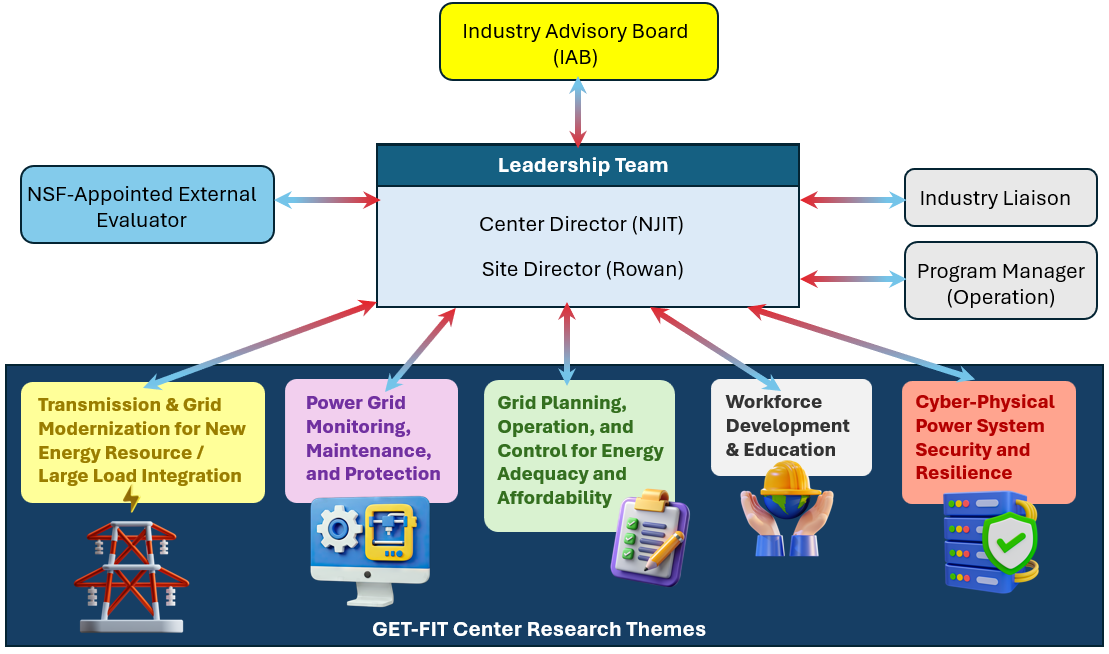
The governance of the center includes several key roles:
- Center Director – responsible for overall center leadership and management
- Site Directors – responsible for coordinating research activities at participating universities
- Academic Leadership Team – the PIs and co-PIs of all participating Sites responsible for overseeing IAB-recommended research activities and ensuring Center success
- Industry Advisory Board (IAB) – representatives from industry member organizations who guide research priorities and vote on project selection
- Industry Liaison Officer – supports communication of Center value, member recruitment, retention, and long-term industry relationship development
This governance structure ensures strong collaboration between industry partners and academic researchers, which is the foundation of the IUCRC program. The organizational structure is illustrated below.
Center Leadership
Center Director
Prof. Philip Pong
Department of Electrical and Computer Engineering
New Jersey Institute of Technology
Prof. Pong oversees the overall management and strategic direction of the GET-FIT Center. His responsibilities include coordinating research activities across participating institutions, engaging industry partners, and guiding the center’s research program.
Site Director – Rowan University
Prof. Jie Li
Department of Electrical and Computer Engineering
Rowan University
Prof. Li leads the Rowan University site and coordinates research activities conducted by faculty investigators and students at Rowan University.
Team Members
NJIT Laboratories
Sensors Laboratory [Prof. Philip Pong]
The Sensors Laboratory develops advanced sensing technologies for monitoring and diagnostics of electric power systems and critical infrastructure. Its work supports GET-FIT research on grid monitoring, system reliability, and advanced measurement technologies for modern power networks. More details.
Intelligent Power Grid Laboratory [Prof. SangWoo Park]
The Intelligent Power Grid Laboratory develops optimization and machine-learning methods for large-scale infrastructure systems. Its research supports GET-FIT efforts in power system operation, grid planning, and intelligent decision-making for future energy networks. More details.
Power System Dynamics Laboratory [Prof. Marcos Netto]
The Power System Dynamics Laboratory studies the dynamics, monitoring, and control of modern electric power systems. Its work contributes to GET-FIT research on grid stability, state estimation, and reliable operation of power systems with high penetration of distributed energy resources. More details.
Control and Optimization Laboratory [Prof. Josh Taylor]
The Control and Optimization Laboratory develops analytical and optimization-based approaches for the operation of modern energy systems. Its research supports GET-FIT activities in power system protection, AC/DC grid operation, and electricity market analysis. More details.
Networked Controls and Intelligent Diagnostics Laboratory [Prof. Mohsen Azizi]
The Networked Controls and Intelligent Diagnostics Laboratory develops advanced control strategies and intelligent fault diagnosis methods for complex engineering systems. Its work supports GET-FIT research on resilient power grids, microgrid control, and intelligent monitoring of energy infrastructure. More details.
Robotics and Data Laboratory [Prof. Pramod Abichandani]
The Robotics and Data Laboratory develops autonomous robotic systems and data-driven algorithms for sensing and decision-making in complex environments. Its research contributes to GET-FIT activities in infrastructure monitoring, inspection technologies, and intelligent sensing platforms for energy systems. More details.
Rowan University Laboratories
Intelligent Power and Energy Systems Research Laboratory [Prof. Jie Li]
The Intelligent Power and Energy Systems Research Laboratory develops real-time simulation platforms and advanced control strategies for modern energy systems. Its work supports GET-FIT research on microgrids, EV charging infrastructure, and the integration of offshore wind and emerging energy technologies. More details.
Wireless Learning and Cognition Laboratory [Prof. Huaxia Wang]
The Wireless Learning and Cognition Laboratory develops AI-enabled robotic platforms for inspection and maintenance of energy infrastructure. Its research supports GET-FIT activities in autonomous inspection, offshore wind maintenance technologies, and intelligent robotic systems. More details.
Functional Materials and Structures Laboratory [Prof. Chen Shen]
The Functional Materials and Structures Laboratory studies wave propagation, vibration, and acoustics for structural health monitoring of engineering systems. Its work contributes to GET-FIT research on sensing technologies and condition monitoring for energy infrastructure and critical structures. More details.
Mechanics of Advanced Materials Laboratory [Prof. Behrad Koohbor]
The Mechanics of Advanced Materials Laboratory investigates the mechanics and design of advanced materials and structural systems. Its research supports GET-FIT efforts in developing resilient materials and structures for energy infrastructure and next-generation engineering systems. More details.